
Blog

Your blog category

Blog

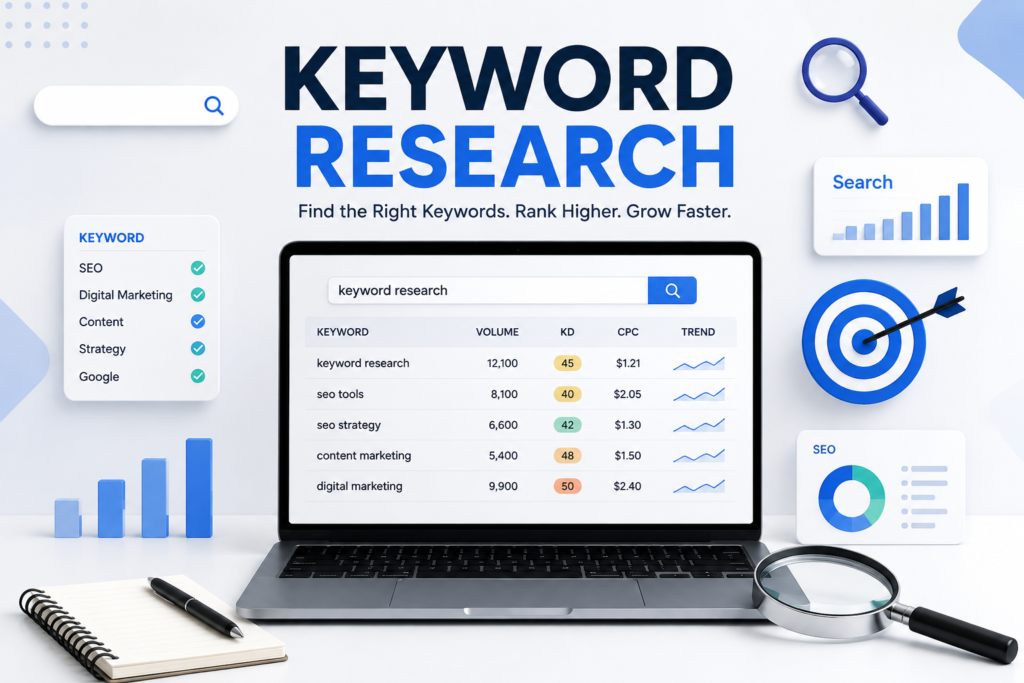
How Keyword Research Improves SEO Ranking

INTRODUCTION Keyword research plays an important role in improving SEO ranking. Keyword research is the process of creating content that includes what users search for in search engines like Google. If the content on our website is the same as what users search for by doing keyword research, search engines like Google give our website more visibility. This increases the ranking. This way, keyword research will help you to get more traffic than your competitors, thereby gradually increasing visibility and trust. Understanding User Search Intent Understanding user search intent is the process of understanding what information a user is looking for when they search for a phrase or phrase in how a user searches. Although a keyword is the same, its purpose is different. Some people search for information, buy products, find websites, etc. Search intent is divided into four categories: navigation, transaction, and commercial investigation. The search content of the keywords we apply will be an exact match if the content is relevant to what the user searched for. This will reduce bounce rate and increase user engagement. Then Google considers our page more important, and thus the ranking increases. It is very important to understand user search intent. Understanding user search intent is the key to SEO success. TYPE OF KEYWORD IN SEO In SEO, keywords are divided into several categories. Each type of keyword can have different purposes. If we analyze it and prepare content accordingly, our website’s ranking and traffic visibility increase. Short-tail keywords refer to those keywords that consist of one or two words. They are mostly in high demand but are very competitive in nature. Examples include SEO, marketing, and others. Big websites and established brands use keywords like these more, and therefore, it is very difficult to rank with such keywords.  In short, it is difficult to understand what the user is searching for by using a keyword.   Long tail keywords are keywords that contain three or more words. With these keywords, you can know very precisely what the users intended to search for.  This keyword will have less competition, so new websites can rank quickly using this keyword. 3. Geo-Targeted Keywords       Geo-targeted keywords are those keywords that are created for a particular location, city, or even country. In case we are targeting our business towards the locals, then this is the right keyword to use. 4. Trending / Fresh Keywords          Trending or fresh keywords are search keywords that have good search potential over a period of time. New updates, news, technology, seasonal topics, etc., will have good search demand for some period of time, but this is not constant. Such keywords stay trending for a few days or months only 5. Evergreen Keywords          Evergreen keywords mean that people will continue to search for these keywords over time. The search demand for these types of keywords will always be constant. These types of keywords are related to basic information, study guides, or topics. 6. LSI (Semantic) Keywords           In ISi, keywords mean creating keywords using words that have the same meaning as the keywords or long phrases. Applying SI keywords helps search engines understand the relevance of the content and also helps avoid keyword stuffing. 7. Navigational Keywords          Navigational keywords are keywords that a user searches for on a website, brand, or page. It is not for the user to know information but to find a brand, page, or website. 8. Intent-Based Keywords (Informational, Transactional, Commercial, Navigational)          An intent-based keyword is a method of providing keywords by understanding what the user is searching for. If the user is coming to know them, then it uses informational keywords. Transactional keywords are used for books, etc., to download or buy a service. Commercial investigation keywords are used to compare and look at reviews before buying something. Navigational keywords are used when users intend to go to a page or website IDENTIFYING WHAT USERS SEARCH FOR One of the most essential factors in SEO is the Identification of users’ searches. It is very important to understand what searches users make, how they search, and what keywords they use. Many times, people make content about things that they already know about, but many successful blogs make content based on what users. For that, you need to understand the keywords that people have used in search engines like Google. You can find out which keywords people are searching for more by using tools like Google Keyword Planner, Ubersuggest, and AnswerThePublic, and you can understand people’s intent by using “People Also Ask” and “Related Searches”.Understanding what people are searching for and tailoring content accordingly leads to higher search demand and page rank, leading to SEO success IMPROVING ON-PAGE SEO WITH KEYWORDS On-page SEO with keywords refers to the process of enhancing content on websites to be easily understood by users and search engines. The choice of the proper keyword is important; however, knowing where to place the right keyword is where the magic lies for successful on-page SEO strategy implementation. The proper placement of keywords via the title tag, meta description, URL, heading tags from H1-H6, opening paragraph, body text, closing paragraph, alternative image text, and internal links can contribute to achieving good rankings. As a search request is submitted, one expects to be presented with websites offering information related to one’s interests. Therefore, the excessive presence of keywords can disrupt the readability of web copy. The last paragraph, image alt text, and internal links will increase the chances of ranking higher. If a user enters a query, they would like to see pages that offer relevant content, so it is better not to stuff keywords in order not to spoil the readability of the content. In addition, it is useful to add latent semantic indexing keywords, synonyms, and relevant searches to the primary keyword. Meta Description – Click-through rate is more likely to increase in Serbia when the keyword appears. It’s good to include keywords in the URL, and adding them to image alt text helps both SEO

Email Marketing Guides For Beginners
Blog

Comprehensive Email Marketing Guides For Beginners 2026

WHAT IS E-MAIL MARKETING Email marketing is a very simple method for beginners, and it provides email marketing guides for beginners. E-mail Marketing for Beginners introduces beginners to the concept of e-mail marketing, which is the use of e-mail marketing as a digital marketing strategy for advertising products and services using e-mail marketing. E-mail marketing enables organizations to maintain good relationships with their customers, create brand awareness, and experience consistent growth. This guide makes it easy for beginners to comprehend the effectiveness of e-mail marketing.   HISTORY OF E-MAIL MARKETING The concept of email marketing came into being as a result of the development of email. With the advancement of technology in the 21st century, there have been improvements in the field of email marketing as well. Email was founded by Ray Tomlinson in 1971. In 1978, the concept of email marketing was developed, as a result of which Gray Turkey, the marketing manager of a company, sent emails to 400 people regarding their products. HOW EMAIL MARKETING WORKS Let’s see how our customers can learn about email marketing services through each process. *LIST BUILDING- It is the process of legally collecting information about people who are interested in your business and sending them offers, updates, and promotions via their email addresses. *ESP SELECTION-Emails are designed, sent to customers, and promoted through email service providers such as MailChimp, Clavio, and Konvettakit. *CONTENT CREATION-Content creation is about providing compelling offers, attractive subject lines, news, useful information, and call-to-action buttons that attract customers to your product or business. *AUTOMATION- Sending messages such as welcome emails, offer emails, birthday greetings, etc., to new or existing customers helps build a good relationship with customers and attracts new subscribers to the business. *ANALYTICS: Through analytical testing, it is possible to know how many people opened the links, how many read them, and which people subscribed and unsubscribed. *DIRECT ACCESS- Messages, offers, and information are sent directly to customers’ emails, so this is a great way to maintain a good relationship with customers ADVANTAGES AND DISADVANTAGES OF EMAIL MARKETING Email marketing has some advantages and disadvantages; let’s see what those are ADVANTAGES *COST-EFFECTIVE- Email marketing is very different from traditional advertising methods, so it is less expensive than traditional advertising methods. It is the best way to reach more people. Email marketing is a very reliable method *INSTANT DELIVERY-Send messages to subscribers’ emails and they will receive them quickly. *PERSONALIZATION AND TARGETING – By understanding the age, location, and interests of subscribers and following them, you can send emails and offer information. *MEASURABLE ROI: We can know how many subscribers clicked on the provided link and how many people opened the link from it. This also gives us details about the traffic coming in. *GLOBAL ACCESIBILITY- You can use this method to contact people in different parts of the world via email or send messages. *BUILDING RELATIONSHIP-Regularly sending email messages and other details to customers. It will help build a good relationship with them. DISADVANTAGES *SPAM PROBLEMS- The chances of most messages sent to customers going to the spam folder are very high. Most messages sent to customers are considered spam. *OVERFLOWING INBOXES- Because customers’ emails receive so many different types of messages, there is a risk that the messages we send will be ignored. THE CHALLENGES OF SECURITY- There is an increased threat of viruses and phishing through emails. *THE PROBLEM WITH THE DESIGN- Emails such as Gmail and Outlook may not be consistent throughout all the email applications, hence posing challenges when reading emails. *LIST BUILDING PROBLEM- It takes time and effort to create a list of which customers to send what messages to. COMPARISON BETWEEN TRADITIONAL MARKETING AND EMAIL MARKETING     Traditional marketing and email marketing are two ways to promote products and services and reach the right people. Let’s look at the difference between them  IN TRADITIONAL MARKETING *COST- Traditional marketing is when a product or service reaches people through newspaper ads, television commercials, billboards, etc. This is a very high-priced method  *REACH- Marketing communications cannot measure exposure to their efforts in terms of audience size and number of individuals reached since there is no way for the marketing communication effort to know who has received its message. *INTERACTIONS- In traditional marketing, even if everyone knows the information, interactions or responses will be very low. Activities such as contacting, sending emails, and replying to learn about the deals or offers will be low. *MEASURABILITY-  It is possible to measure the success of a marketing campaign using data such as email open rate and click rate, but in traditional marketing, the possibility of doing so is very low. It is difficult to know customer reviews. IN EMAIL MARKETING *COST –  Email  Marketing is done by sending a message to a customer via email. This is very cost-effective. Since everything is done digitally, there are no additional costs like traditional marketing. *REACH- For reaching people through email marketing, the aspect of reach lies in the number of individuals that can be contacted by means of communication and notifications. The reach is enhanced because the communication can reach out globally and reach thousands of individuals. *INTERACTIONS- For interactions through email marketing, once the communications reach their destinations, they would interact through emails, phone calls, and click-reply systems. Interactions in email marketing are direct interactions. *MEASURABILITY-  In email marketing, the performance of an email campaign can be easily measured using data such as open rate, click rate, and conversion rate. This is called measurability. In email marketing, this is very easy and convenient because you can know the customer response. TOOLS AND PLATFORMS OF EMAIL MARKETING   *MAILCHIMP *KLAVIYO *BREVO *OMNISEND *CONVERTKIT *HUBSPOT *MAILERLITE *ACTIVE CAMPAIGN CONCLUSION To conclude, email marketing appears to be among the most effective and economical ways that a beginner can employ to communicate with customers directly. Being able to build an excellent email list and regularly sending email messages that contain useful content, you will manage to develop trust

Scroll to Top