
INTRODUCTION
Table of Contents
Keyword research plays an important role in improving SEO ranking. Keyword research is the process of creating content that includes what users search for in search engines like Google. If the content on our website is the same as what users search for by doing keyword research, search engines like Google give our website more visibility. This increases the ranking. This way, keyword research will help you to get more traffic than your competitors, thereby gradually increasing visibility and trust.
Understanding User Search Intent
Understanding user search intent is the process of understanding what information a user is looking for when they search for a phrase or phrase in how a user searches. Although a keyword is the same, its purpose is different. Some people search for information, buy products, find websites, etc.
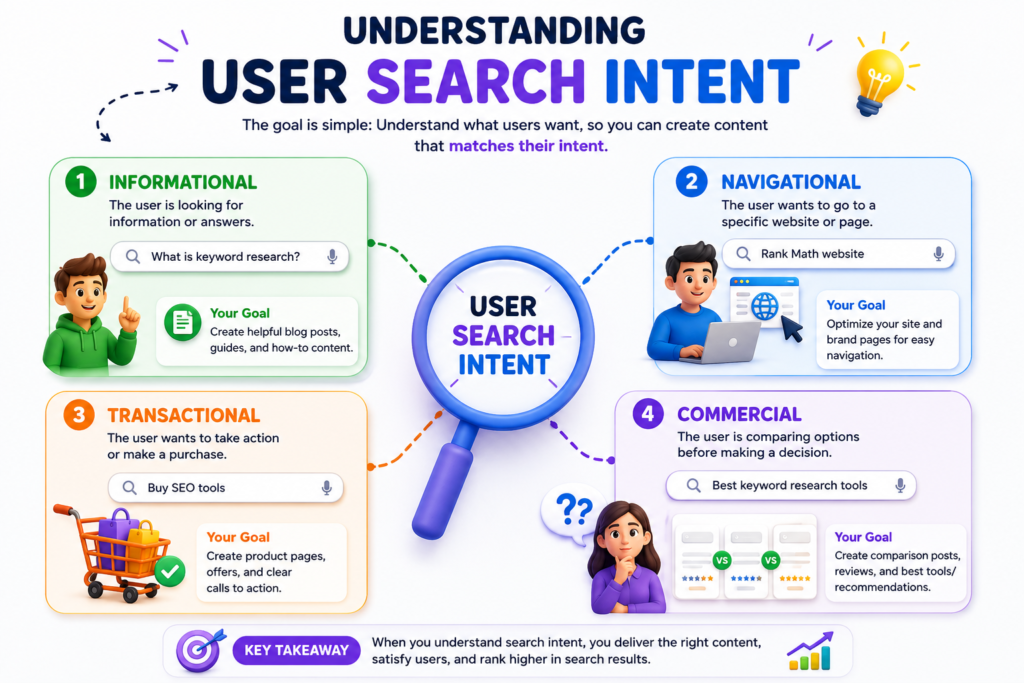
Search intent is divided into four categories: navigation, transaction, and commercial investigation. The search content of the keywords we apply will be an exact match if the content is relevant to what the user searched for. This will reduce bounce rate and increase user engagement. Then Google considers our page more important, and thus the ranking increases. It is very important to understand user search intent. Understanding user search intent is the key to SEO success.
TYPE OF KEYWORD IN SEO
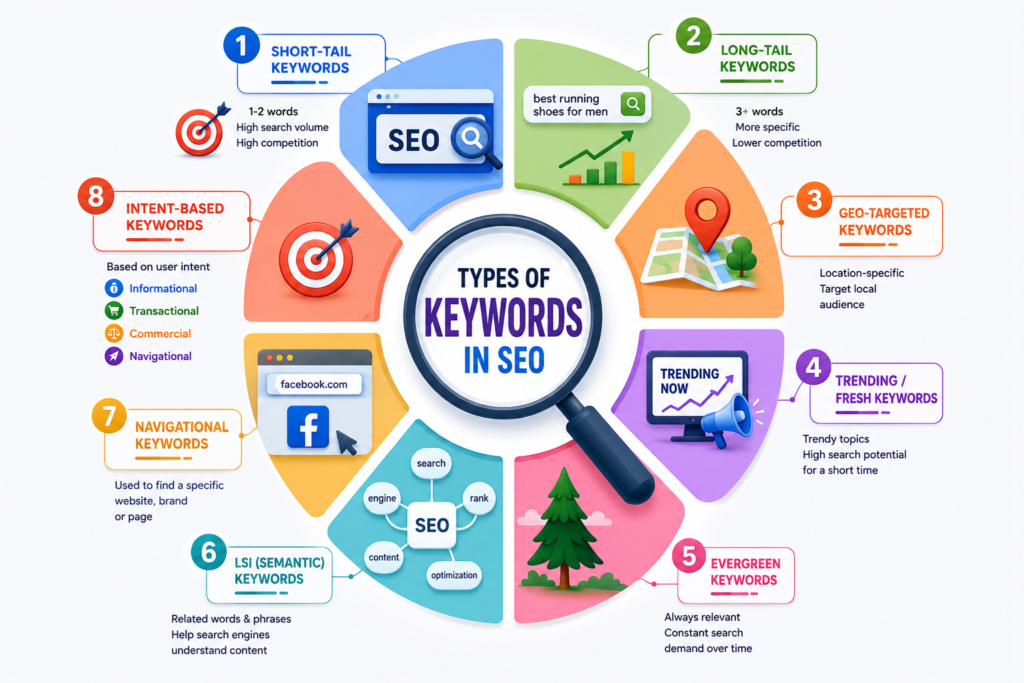
In SEO, keywords are divided into several categories. Each type of keyword can have different purposes. If we analyze it and prepare content accordingly, our website’s ranking and traffic visibility increase.
- Short-Tail Keywords
Short-tail keywords refer to those keywords that consist of one or two words. They are mostly in high demand but are very competitive in nature. Examples include SEO, marketing, and others. Big websites and established brands use keywords like these more, and therefore, it is very difficult to rank with such keywords. In short, it is difficult to understand what the user is searching for by using a keyword.
- Long-Tail Keywords
Long tail keywords are keywords that contain three or more words. With these keywords, you can know very precisely what the users intended to search for. This keyword will have less competition, so new websites can rank quickly using this keyword.
3. Geo-Targeted Keywords
Geo-targeted keywords are those keywords that are created for a particular location, city, or even country. In case we are targeting our business towards the locals, then this is the right keyword to use.
4. Trending / Fresh Keywords
Trending or fresh keywords are search keywords that have good search potential over a period of time. New updates, news, technology, seasonal topics, etc., will have good search demand for some period of time, but this is not constant. Such keywords stay trending for a few days or months only
5. Evergreen Keywords
Evergreen keywords mean that people will continue to search for these keywords over time. The search demand for these types of keywords will always be constant. These types of keywords are related to basic information, study guides, or topics.
6. LSI (Semantic) Keywords
In ISi, keywords mean creating keywords using words that have the same meaning as the keywords or long phrases. Applying SI keywords helps search engines understand the relevance of the content and also helps avoid keyword stuffing.
7. Navigational Keywords
Navigational keywords are keywords that a user searches for on a website, brand, or page. It is not for the user to know information but to find a brand, page, or website.
8. Intent-Based Keywords (Informational, Transactional, Commercial, Navigational)
An intent-based keyword is a method of providing keywords by understanding what the user is searching for. If the user is coming to know them, then it uses informational keywords. Transactional keywords are used for books, etc., to download or buy a service. Commercial investigation keywords are used to compare and look at reviews before buying something. Navigational keywords are used when users intend to go to a page or website
IDENTIFYING WHAT USERS SEARCH FOR
One of the most essential factors in SEO is the Identification of users’ searches. It is very important to understand what searches users make, how they search, and what keywords they use. Many times, people make content about things that they already know about, but many successful blogs make content based on what users. For that, you need to understand the keywords that people have used in search engines like Google. You can find out which keywords people are searching for more by using tools like Google Keyword Planner, Ubersuggest, and AnswerThePublic, and you can understand people’s intent by using “People Also Ask” and “Related Searches”.Understanding what people are searching for and tailoring content accordingly leads to higher search demand and page rank, leading to SEO success
IMPROVING ON-PAGE SEO WITH KEYWORDS
On-page SEO with keywords refers to the process of enhancing content on websites to be easily understood by users and search engines. The choice of the proper keyword is important; however, knowing where to place the right keyword is where the magic lies for successful on-page SEO strategy implementation. The proper placement of keywords via the title tag, meta description, URL, heading tags from H1-H6, opening paragraph, body text, closing paragraph, alternative image text, and internal links can contribute to achieving good rankings.
As a search request is submitted, one expects to be presented with websites offering information related to one’s interests. Therefore, the excessive presence of keywords can disrupt the readability of web copy.
The last paragraph, image alt text, and internal links will increase the chances of ranking higher.
If a user enters a query, they would like to see pages that offer relevant content, so it is better not to stuff keywords in order not to spoil the readability of the content. In addition, it is useful to add latent semantic indexing keywords, synonyms, and relevant searches to the primary keyword.
Meta Description – Click-through rate is more likely to increase in Serbia when the keyword appears. It’s good to include keywords in the URL, and adding them to image alt text helps both SEO and accessibility.
and SEO. Keyword-based links to pages with good internal linking are also very good.
This is an important way to improve on-page SEO if the keyword is used correctly at the right levels, so that the content can be understood by people and easily recognized by search engines.
TOOLS FOR EFFECTIVE KEYWORD RESEARCH ON GOOGLE
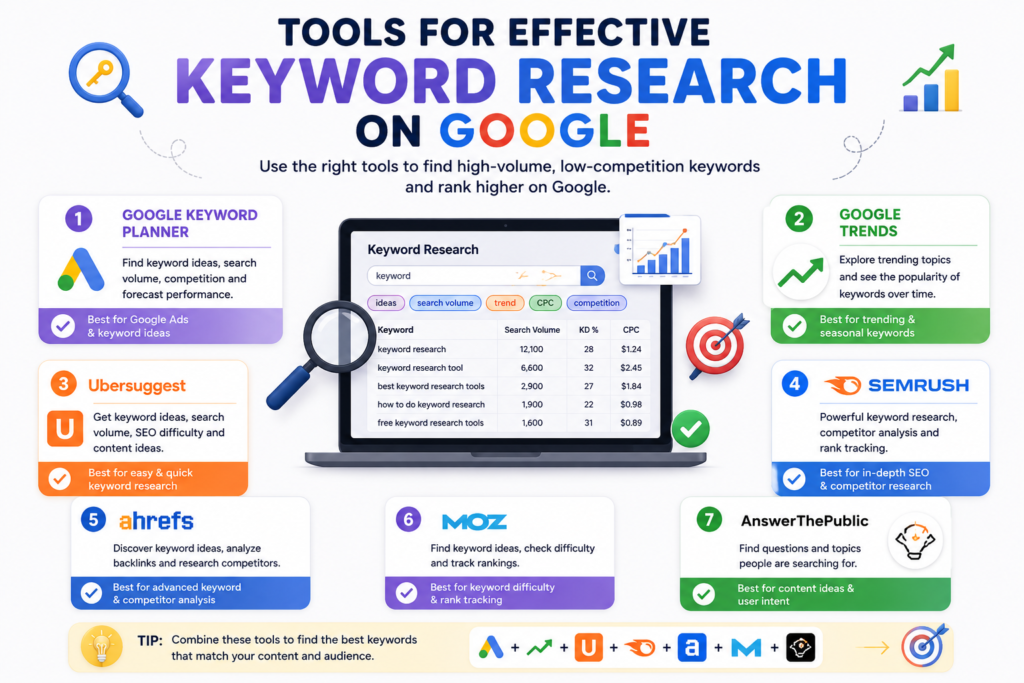
There are some tools based on Google for blogging and website optimization, which can be used to find effective keywords.
1. Google Keyword Planner- It is a tool related to Google Ads that can be used to find search volume, competition, and related keywords. Very useful for SEO
2. Google Trends- This tool can be used to understand whether a keyword is trending or not, and its seasonal interest.
3. Google Search Console- It is possible to understand what kind of searches people come to our website
4. Answer the public—get answers to questions and phrases about a topic. Long keywords are easy to find
5. Soovle – Many platforms, such as Google, YouTube, Amazon, and others, show autocomplete ideas together.
COMMON KEYWORD RESEARCH MISTAKE
Keyword research is the basis of SEO success. But many people make small mistakes. Keyword research is an important factor for a blog or website to rank. When you understand what users are researching and prepare the content accordingly, the blog or website is more likely to rank and get traffic. SEO success cannot be achieved without proper keyword research. Therefore, keyword research is an important factor. Rather, it is a strategic investment towards digital success.
It also goes without saying that you should pay enough attention to the rank in Google. Not choosing the right keywords. Not understanding what people are looking for. Choose keywords that only look for high search volume. Avoiding long-tail keywords is a common mistake. Google will consider keyword stuffing a mistake. Not recognizing the trend is also a problem. Keyword research should be done strategically by considering user needs, competition, search intent, long-tail keywords, and LSI keywords.
CONCLUSION
Keyword research is an important factor for a blog or website to rank. When you understand what users are researching and prepare the content accordingly, the blog or website is more likely to rank and get traffic. SEO success cannot be achieved without proper keyword research. Therefore, keyword research is an important factor. Rather, it is a strategic investment towards digital success.